Bridging Web2 to Web3: How to Connect a PHP Website to a Smart Contract
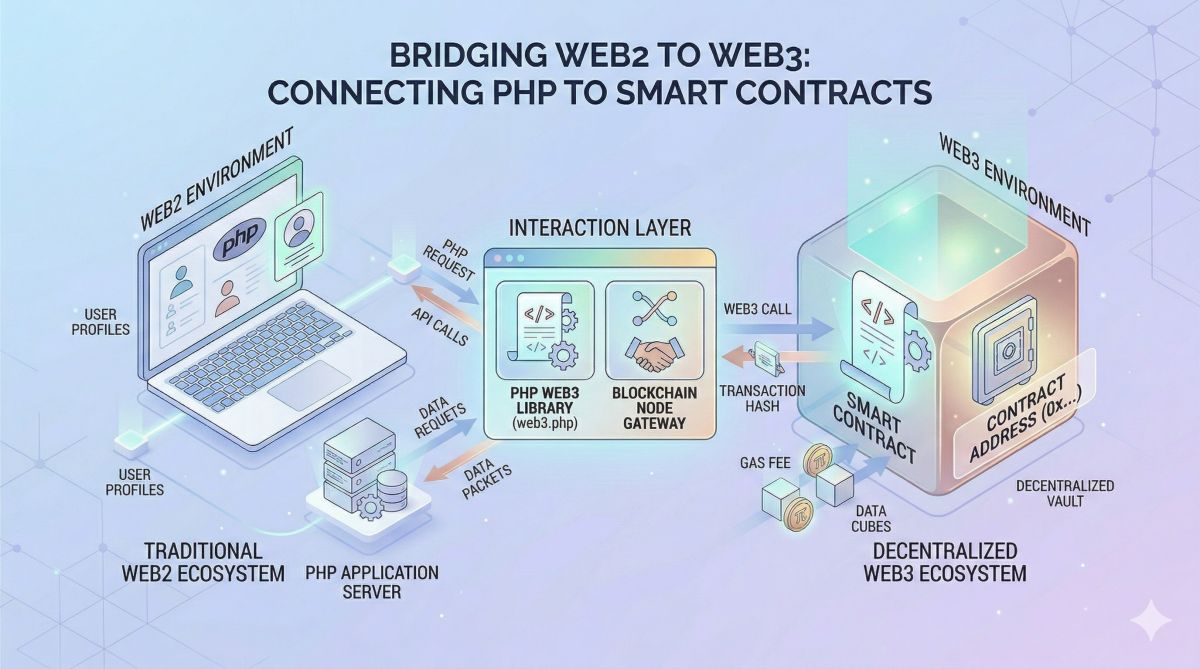
Transitioning from traditional web development to the decentralized web can feel overwhelming, especially when trying to connect a legacy PHP backend to a modern smart contract. Many developers mistakenly believe that Web3 requires abandoning PHP entirely in favor of JavaScript-heavy frontends. From my experience building the infrastructure at Zanachain, I can assure you that PHP remains a powerhouse for secure, server-side blockchain interactions. In this definitive guide, I will show you exactly how to bridge Web2 and Web3. We will explore setting up JSON-RPC nodes, utilizing PHP libraries to query smart contracts securely, and building a hybrid backend architecture that protects your users and scales flawlessly.
The Web2.5 Reality: Why PHP is Still Crucial in Web3
When beginners enter the blockchain space, they are immediately introduced to JavaScript libraries like Web3.js or Ethers.js. Because these libraries run directly in the user's browser, there is a massive misconception that backend languages like PHP are obsolete in the decentralized era. This is factually incorrect.
Welcome to the concept of Web2.5. Not every piece of data needs to be, or should be, stored on the blockchain. Storing large amounts of text, user profile images, or relational data on a smart contract is astronomically expensive due to gas fees. The most successful decentralized applications (dApps) use a hybrid approach: they use a traditional PHP/MySQL backend to serve the website, manage user sessions, and cache non-critical data, while strictly using the blockchain for financial transactions and ownership verification.
Understanding the Bridge: The JSON-RPC Protocol
So, how does a PHP server actually talk to a blockchain network like Ethereum, Binance Smart Chain, or Pi Network? It doesn't magically speak Solidity. It communicates using a standard protocol called JSON-RPC.
Every blockchain network is maintained by "Nodes." These nodes expose an API endpoint. Your PHP backend simply sends an HTTP POST request containing a specifically formatted JSON payload to this node. The node queries the blockchain and returns the result (like a token balance or the total supply of an NFT) back to your PHP script. You can then format this data using standard HTML/CSS and serve it to your users.
Architectural Comparison: Frontend vs. Backend Blockchain Queries
Deciding whether to query the blockchain directly from the user's browser or route it through your PHP backend is a critical architectural decision. Here is a breakdown of why routing through PHP is often superior for specific tasks:
| Feature | Frontend (JavaScript / Browser) | Backend Bridge (PHP Server) |
|---|---|---|
| API Key Security | Exposed in the browser (High Risk) | Hidden on the server (Secure) |
| Caching Data | Relies on user's local cache | Server-side caching (e.g., Redis / LSCache) |
| RPC Node Limits | Users might hit rate limits easily | Server controls request volume seamlessly |
| SEO Indexing | Poor (Google bots struggle with JS data) | Excellent (Data is rendered as pure HTML) |
Implementing the Connection: PHP Web3 Libraries
While you can manually construct cURL requests in PHP to talk to a JSON-RPC node, it is highly inefficient when dealing with complex smart contract data, which requires precise hexadecimal encoding. Instead, modern PHP developers utilize specialized libraries. The most popular approach is using Composer packages like web3.php.
Here is the logical flow of how a PHP script reads data from a smart contract:
- The Provider: You initialize the connection by providing the URL of your RPC node (e.g., an Infura or Alchemy endpoint).
- The ABI (Application Binary Interface): You must supply your PHP script with the ABI of the smart contract. Think of the ABI as a dictionary. It tells your PHP code exactly what functions exist inside the smart contract and what parameters they require.
- The Contract Address: You specify the hexadecimal address of the deployed smart contract on the blockchain.
- The Call: Using the library, you execute a "Read" function (like
balanceOf). The library encodes this request, sends it via HTTP to the node, decodes the hexadecimal response, and returns a usable PHP variable.
Writing to the Blockchain: The Security Line You Must Not Cross
Reading data from the blockchain using PHP is entirely safe. However, writing data to the blockchain (executing a transaction that changes the state of a smart contract) requires a cryptographic signature from a Private Key.
This is the golden rule of Web3 backend development: Never store a user's private key on your PHP server to sign transactions on their behalf. If your server is compromised, all user funds will be stolen. Instead, the correct Web2.5 architecture uses PHP to prepare the transaction data and serve it to the frontend. The user's local Web3 wallet (like MetaMask or Pi Wallet) then pops up, asking the user to sign the transaction safely on their own device.
Protecting Your PHP Bridge: Best Practices
When you build a bridge between Web2 and Web3, your PHP server becomes a high-value target. During the development of Zanachain's infrastructure, implementing these security measures proved vital:
- Environment Variables (.env): Never hardcode your RPC endpoint URLs or server-side API keys in your
.phpfiles. Use a library likevlucas/phpdotenvto load them securely from a file located completely outside of your public HTML directory. - Strict Rate Limiting: If a malicious actor spams your PHP endpoint that queries the blockchain, your RPC provider will quickly exhaust its daily quota, taking your dApp offline. Implement strict IP-based rate limiting within your PHP logic or directly at the OpenLiteSpeed server level.
- Data Caching: Blockchain data doesn't always need to be fetched in real-time. If you are displaying the total supply of a token, query the blockchain once every 5 minutes using a PHP cron job, save the result to your MySQL database or a Redis cache, and serve the cached data to your users. This drastically reduces API costs and load times.
Conclusion: The Best of Both Worlds
Building a successful decentralized application does not mean throwing away decades of proven web development practices. By intelligently combining the speed, SEO capabilities, and security of a PHP backend with the trustless, immutable ledger of a smart contract, you create a robust "Web2.5" architecture. This bridge is the key to creating dApps that are not only technologically advanced but also lightning-fast, secure, and ready for mass adoption.