Hosting Web3 dApps: Optimizing CyberPanel and OpenLiteSpeed for Blockchain Projects
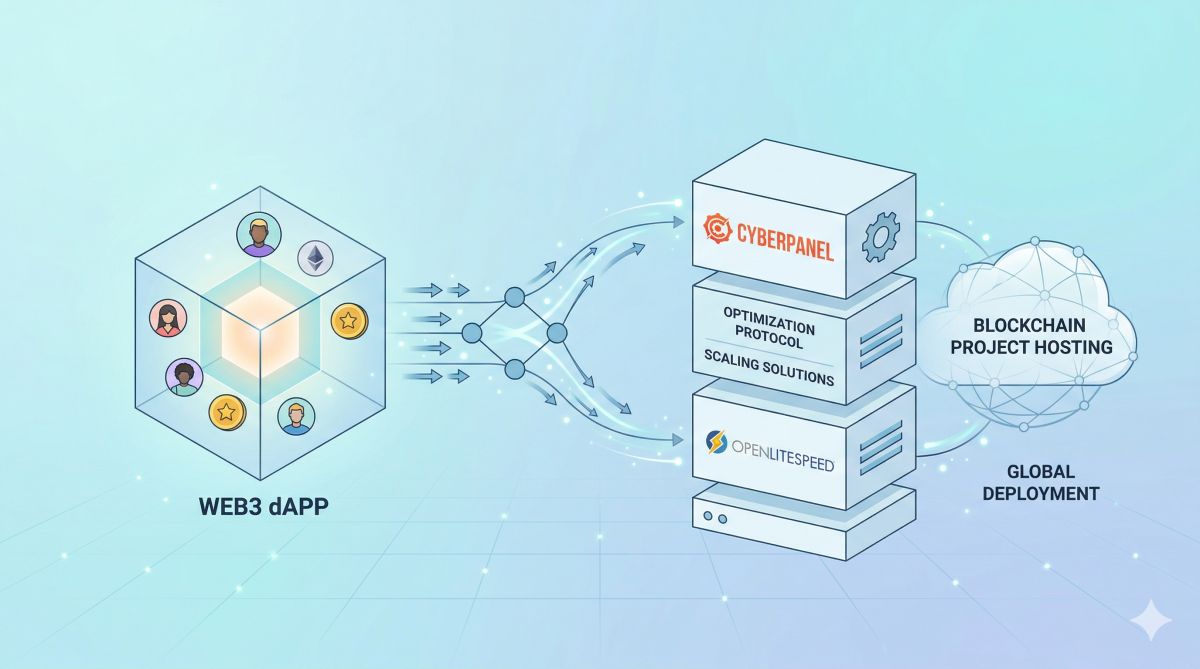
Building a revolutionary Web3 decentralized application is only half the battle; hosting its frontend efficiently is where many developers fail. Traditional hosting environments struggle with the high-concurrency demands and rapid API calls required by modern dApps interacting with blockchain networks. If you want your Web3 project to scale without crashing, you need a robust, lightning-fast server architecture. In this comprehensive guide, I will share the firsthand technical experience of optimizing CyberPanel and OpenLiteSpeed to host decentralized applications. We will dive deep into advanced caching strategies, conquering frustrating 403 and 404 routing errors, and configuring PHP to create a secure, high-performance bridge to the blockchain.
The Web3 Hosting Dilemma: Why Server Architecture Still Matters
There is a common misconception in the Web3 space that because smart contracts live on a decentralized blockchain (like Ethereum or Pi Network), traditional web hosting no longer matters. This could not be further from the truth. While the logic and financial transactions are decentralized, the user interface—the HTML, CSS, JavaScript, and PHP backend that connects your users to the blockchain—still relies on Web2 infrastructure.
If your frontend server is slow, your users will experience delayed wallet connections, timed-out RPC (Remote Procedure Call) requests, and a generally poor user experience. To achieve the mass adoption we envision at ZanaChain, your dApp must feel as fast and responsive as a traditional Web2 application. This requires moving away from legacy hosting control panels and embracing modern, event-driven server architectures.
Why CyberPanel and OpenLiteSpeed?
After testing various server stacks for blockchain development, the combination of CyberPanel and OpenLiteSpeed (OLS) stands out as the ultimate solution. OpenLiteSpeed is highly scalable, requires significantly less CPU and RAM overhead compared to traditional setups, and handles concurrent connections brilliantly—a strict requirement when thousands of users are querying blockchain data simultaneously.
Performance Comparison: The Heavyweights
To understand why this architecture is superior for Web3 workloads, let's look at a comparative breakdown of the most popular web servers:
| Server Feature | Apache | Nginx | OpenLiteSpeed (OLS) |
|---|---|---|---|
| Architecture | Process-driven (Heavy) | Event-driven (Light) | Event-driven (Ultra-light) |
| Web3 Concurrency | Struggles under high load | Excellent | Superior (Native LSCache) |
| Rewrite Rules | Native .htaccess support | Requires custom config | Supports .htaccess (Requires Restart) |
| PHP Performance | Standard (mod_php/FPM) | Fast (PHP-FPM) | Fastest (LSPHP) |
Conquering the Dreaded 403 and 404 Routing Errors
One of the most frustrating experiences when deploying a modern Web3 frontend (especially Single Page Applications built with React, Vue, or complex PHP routing) on CyberPanel is encountering sudden 403 Forbidden or 404 Not Found errors when users refresh the page.
This happens because the frontend router is handling the URLs dynamically, but OpenLiteSpeed is looking for a physical file that does not exist. To fix this, you must configure your rewrite rules correctly. Inside your CyberPanel dashboard, navigate to your website's configuration and edit the rewrite rules (or modify your .htaccess file directly) to include the following fallback:
RewriteEngine On
RewriteCond %{REQUEST_FILENAME} !-f
RewriteCond %{REQUEST_FILENAME} !-d
RewriteRule ^ index.php [QSA,L]
Crucial Developer Tip: Unlike Apache, which reads the .htaccess file dynamically on every request, OpenLiteSpeed caches these rules. If you update your rewrite rules to fix a 404 error, the changes will not take effect immediately. You must perform a graceful restart of OpenLiteSpeed via the CyberPanel dashboard or SSH for the new routing to work.
Optimizing PHP for Blockchain RPC Connections
When your server acts as a bridge between the user and the blockchain, your PHP backend is constantly making API calls to RPC nodes to fetch wallet balances, verify transactions, or execute smart contracts. Blockchain networks can occasionally experience congestion, causing these API calls to take longer than normal web requests.
If your PHP settings are not optimized, these delays will cause fatal timeout errors. Within CyberPanel, locate your PHP settings (specifically the php.ini configuration for the LSPHP version you are running) and adjust the following parameters:
- max_execution_time: Increase this from the default 30 seconds to 120 or 180 seconds. This prevents your PHP script from dying while waiting for a slow RPC node to confirm a transaction.
- memory_limit: Web3 libraries and cryptographic functions can be memory-intensive. Bump this up to 256M or 512M.
- default_socket_timeout: Ensure this matches your execution time to prevent premature socket closures during external API calls.
Frontend Delivery: Perfecting CSS for Mobile Web3 Users
Your server architecture can be incredibly fast, but if your frontend design is broken, users will abandon your dApp. A significant portion of Web3 interactions happens on mobile devices (especially within ecosystems like the Pi Network Browser). Therefore, your CSS files must be flawlessly optimized for mobile responsiveness.
When developing the UI, ensure your maximum container widths (e.g., using max-width: 550px; for specific mobile-focused dApp modals) and flexbox layouts are thoroughly tested. OpenLiteSpeed's LSCache plugin can automatically minify your CSS and PHP output, reducing file sizes by up to 30%. This guarantees that when a user clicks "Connect Wallet," the interface renders in milliseconds, providing the premium experience expected in modern Web3 applications.
Conclusion: Building on a Solid Foundation
The transition from Web2 to Web3 requires more than just learning smart contract development; it demands a deep understanding of how to bridge the two worlds efficiently. By harnessing the power of CyberPanel and OpenLiteSpeed, mastering rewrite rules to eliminate 403/404 errors, and fine-tuning your PHP environment for blockchain interactions, you create a resilient, high-performance infrastructure.
As we continue to build and scale the dApps of tomorrow, remember that the reliability of your hosting environment is the silent engine driving your project's success. Optimize your server, secure your endpoints, and build the decentralized future with confidence.