The Evolution of Web3: From Centralization to User Ownership
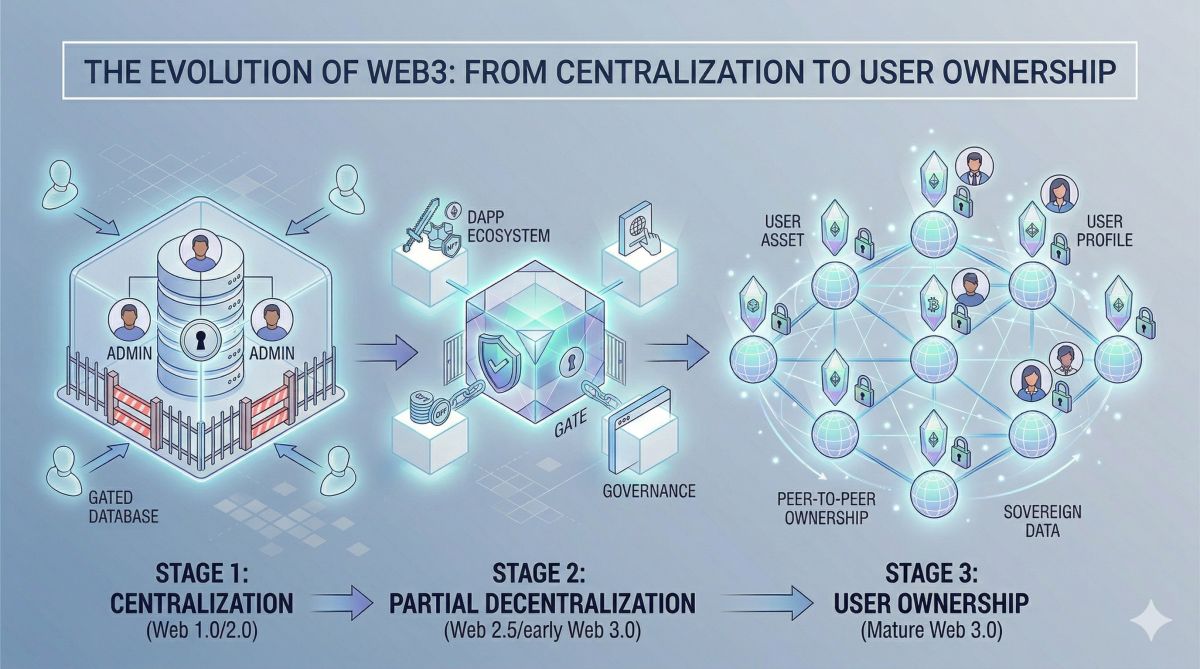
The internet is currently undergoing its most significant transformation since the 1990s. We are moving away from the era of "Digital Feudalism," where a few tech giants own our data, toward a new frontier of User Ownership. Known as Web3, this evolution uses blockchain technology to return power to the individual. In this era, you don't just browse the web or post content—you own your digital identity, your assets, and your financial future. At ZanaChain, we are building at the heart of this revolution, ensuring that the transition from centralized control to decentralized freedom is seamless, secure, and accessible for everyone.
The Three Ages of the Internet: Read, Write, Own
To understand where we are going, we must look at where we started. The internet’s history can be categorized into three distinct "Read/Write" phases:
Web1: The "Read-Only" Era (1990 - 2004)
Web1 was the "Static Web." It consisted of simple HTML pages that users could read but not interact with. There were no social media likes, no comments, and no profile pictures. It was essentially a digital library. You went online to find information, and once you found it, you left. The power was held by the few who knew how to code and host servers.
Web2: The "Read-Write" Era (2004 - Present)
Web2 is the "Social Web." It introduced platforms like Facebook, YouTube, and Twitter, allowing users to create their own content. However, this convenience came with a hidden price tag: Centralization. In Web2, you generate the content, but the corporation owns the data. If a platform decides to delete your account or sell your browsing history to advertisers, you have zero control. You are not the customer; you are the product.
Web3: The "Read-Write-Own" Era (2020 - Future)
Web3 is the "Decentralized Web." Built on the foundation of blockchain, it replaces centralized servers with a global network of nodes. For the first time in history, the internet allows for Digital Scarcity and True Ownership. You don't "log in" to Web3; you "connect" your wallet. You don't "rent" your profile; you "own" your DID (Decentralized Identifier).
The Core Pillars of Web3 Innovation
What makes Web3 fundamentally different from the internet we use today? It boils down to four revolutionary pillars:
1. Decentralization and Trustlessness
In Web2, you must "trust" that a bank will send your money or a social media site will keep your private messages safe. In Web3, you don't need trust—you have Cryptography. Smart contracts are open-source codes that execute automatically when conditions are met. No human intervention, no bias, and no central point of failure.
2. Digital Sovereignty and Ownership
Whether it is your Pi Network coins, an NFT representing your home’s deed, or your medical records, Web3 ensures that You hold the keys. Through non-custodial wallets, your assets cannot be frozen, seized, or censored by any government or corporation. This is the ultimate form of financial and digital freedom.
3. Permissionless Access
The traditional financial system excludes billions of people because they lack a credit score or a specific passport. Web3 is permissionless. Anyone with a smartphone and an internet connection can access global DeFi (Decentralized Finance) markets, lending protocols, and international trade—no "approval" needed.
4. Tokenized Economies (Tokenomics)
Web3 introduces the concept of "Incentive Alignment." Unlike Web2, where the platform keeps 100% of the profit, Web3 protocols distribute value back to the users and developers through tokens. This creates a circular economy where everyone who contributes to the network’s growth also shares in its financial success.
ZanaChain and the Web3 Transition
At ZanaChain, we recognize that while Web3 is powerful, it can also be complex. Our mission is to act as the bridge between the centralized past and the decentralized future. By building user-friendly dApps on robust ecosystems like the Pi Network, we are making "User Ownership" a reality for the average person, not just tech experts.
By leveraging Protocol 20 smart contracts and secure DID systems, we are creating a digital environment where your privacy is protected by default, and your contributions are rewarded by design. We believe the "Evolution of Web3" is not just a technological shift—it is a human rights movement for the digital age.
Frequently Asked Questions (FAQ)
1. Is Web3 the same as the Metaverse?
No, but they are related. Web3 is the infrastructure (blockchain, ownership, tokens) that powers a decentralized internet. The Metaverse is the interface (VR, AR, 3D spaces) through which we might experience that internet. You can have Web3 without the Metaverse, but a truly open Metaverse requires Web3 for ownership.
2. Why is Web3 often associated with high energy use?
This was a concern with early "Proof of Work" blockchains like Bitcoin. However, modern Web3 infrastructure (like the Pi Network or Ethereum 2.0) uses "Proof of Stake" or "Stellar Consensus Protocol," which use 99% less energy—making Web3 more sustainable than the centralized server farms of Web2.
3. Can Web3 coexist with Web2?
Absolutely. We are currently in a "Web2.5" phase where many traditional companies are integrating Web3 features (like Nike's NFTs or PayPal's crypto support). Over time, the decentralized backend will likely become the standard for the entire internet.
Conclusion: The Great Migration to Freedom
The evolution of Web3 is inevitable. As more people realize the value of their personal data and the risk of centralized censorship, the migration to user-owned platforms will only accelerate. We are moving from an internet of "information" to an internet of "value." At ZanaChain, we are honored to be part of this journey, building the tools and dApps that will define the next decade of human interaction. The future doesn't belong to the platforms—it belongs to you.