Understanding Blockchain Security and Why It Matters
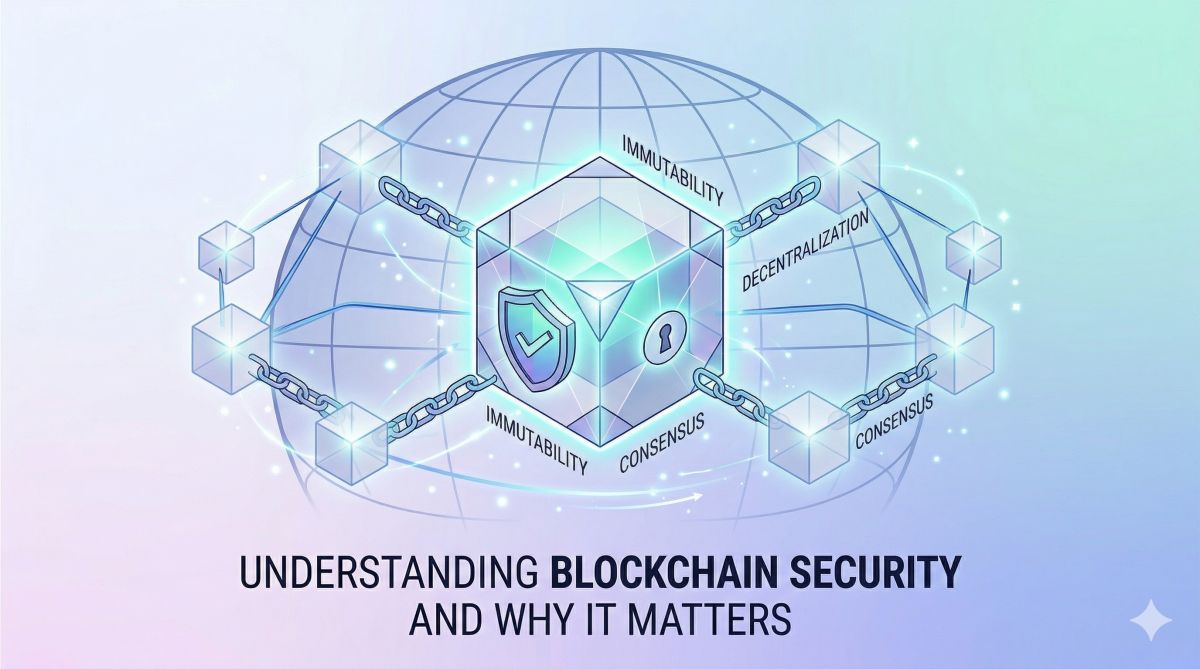
Blockchain technology is often called "unhackable," but true security in the Web3 era is a multi-layered fortress of mathematics, decentralized consensus, and personal responsibility. Unlike traditional banks that store your data on a single, vulnerable server, a blockchain distributes its records across thousands of global nodes, making unauthorized changes virtually impossible. At ZanaChain, we believe that understanding the cryptographic "armor" of a network is the first step toward digital sovereignty. From private key management to smart contract auditing, this guide explores the invisible forces that keep your digital assets safe in an increasingly decentralized world.
The Anatomy of an Immutable Ledger
What makes a blockchain so difficult to manipulate? It comes down to its unique structural design. Every transaction is grouped into a "block," and each block contains a "Hash"—a unique digital fingerprint—of the block that came before it. This creates a chronological, unbreakable chain.
If a hacker attempts to change a single transaction in an old block, the Hash of that block changes. Because the next block is linked to the old Hash, the entire chain becomes invalid. To successfully "hack" the ledger, an attacker would need to recalculate every subsequent block and take control of more than 51% of the network’s total computing power (or nodes) simultaneously. In a large network like Pi or Bitcoin, the cost of such an attack is trillions of dollars, making it economically impossible.
The Two Pillars of Defense: Cryptography and Consensus
Blockchain security isn't just about the "chain"; it's about the rules that govern it. There are two primary defense mechanisms at work:
1. Asymmetric Cryptography (Private vs. Public Keys)
In Web3, your identity is split into two parts. Your Public Key is like your IBAN or email address—you can share it with anyone to receive funds. Your Private Key (or Seed Phrase) is the digital signature that authorizes a transfer. Without that signature, even the smartest hacker cannot move a single coin out of your wallet. This puts the user in total control, but also gives them total responsibility.
2. Consensus Mechanisms (The Global Jury)
How do thousands of computers agree that a transaction is legitimate? They use consensus. Whether it’s Proof of Work (computation), Proof of Stake (collateral), or the Stellar Consensus Protocol (trust circles used by Pi), these systems ensure that no single entity can dictate what is true. Every node acts as an independent auditor, verifying every transaction in real-time.
The "Weakest Link": Where Blockchain Fails
It is a hard truth: while the Blockchain is secure, the Applications and Users often aren't. At ZanaChain, we identify three main risk areas:
- Smart Contract Vulnerabilities: A smart contract is just code. If the developer leaves a "backdoor" or a bug (like an overflow error), a hacker can exploit it. This is why ZanaChain advocates for Professional Audits before any dApp is launched on the Mainnet.
- Phishing and Social Engineering: Most "crypto hacks" aren't hacks at all—they are scams. A user is tricked into clicking a link that looks like an official Pi Network site and unknowingly gives away their passphrase.
- Exchange Risks: Centralized exchanges (CEX) are honey pots for hackers. Keeping your coins on an exchange means you are trusting their security instead of the blockchain’s security.
ZanaChain's Security Philosophy
We build our dApps with a "Security by Design" approach. By leveraging the robust, KYC-verified infrastructure of the Pi Network and the advanced logic of Protocol 20, we ensure that every interaction within the ZanaChain ecosystem is transparent and verifiable. We prioritize user education because we know that a well-informed Pioneer is the strongest firewall a network can have.
Frequently Asked Questions (FAQ)
1. Can a blockchain be hacked by a Quantum Computer?
This is a future concern. While current quantum computers aren't powerful enough to break modern cryptography, the blockchain industry is already developing "Quantum-Resistant" algorithms to stay one step ahead of future technology.
2. Is a "51% Attack" possible on the Pi Network?
Pi uses the Stellar Consensus Protocol (SCP), which relies on a "Web of Trust" rather than just computing power. This makes a 51% attack significantly harder than on traditional Proof of Work chains, as the attacker would need to be "trusted" by thousands of independent security circles.
3. Why can't I just call someone to reset my wallet password?
Because there is no "someone." That is the beauty—and the danger—of decentralization. There is no central server storing your password. If you lose your keys, the math that protects your coins also prevents you from accessing them.
Conclusion: The Future of Trust
Blockchain security is fundamentally changing how we trust. We are moving from a world of "Institutional Trust" (trusting a bank) to a world of "Algorithmic Trust" (trusting mathematics). As we move deeper into the 2026 Web3 era, security will no longer be an afterthought—it will be the foundation of global finance, healthcare, and digital identity. At ZanaChain, we are proud to be part of this secure future, building the tools that protect your digital freedom every day.