What Are Smart Contracts? Automated Agreements on Blockchain
When we talk about the revolutionary power of blockchain, we often focus on digital money like Bitcoin. But what happens when you want to use blockchain for more than just sending and receiving funds? What if you want to build complex, automated systems without relying on a middleman? This is where Smart Contracts step in. At ZanaChain, smart contracts are the absolute core of the decentralized applications (dApps) we envision and build for the Web3 ecosystem.
In this guide, we will dive into what automated agreements are, how they function securely on the blockchain, and why they are replacing traditional legal frameworks in the digital world.
What Are Smart Contracts?
A smart contract is exactly what it sounds like: a contract that is "smart" because it executes itself. It is a digital agreement where the rules, conditions, and terms are written directly into lines of code rather than printed on paper. Once this code is deployed onto a blockchain (like Ethereum, Binance Smart Chain, or networks within the Pi ecosystem), it becomes immutable. No one can change the rules after the fact.
The Vending Machine Analogy: The easiest way to understand a smart contract is to think of a traditional vending machine. You don't need a cashier to buy a soda. You simply drop in a coin and press a button (the condition). The machine's internal mechanics verify the coin and automatically drop the soda (the execution). A smart contract does the exact same thing, but for digital assets, loans, real estate, and more.
How Smart Contracts Actually Work
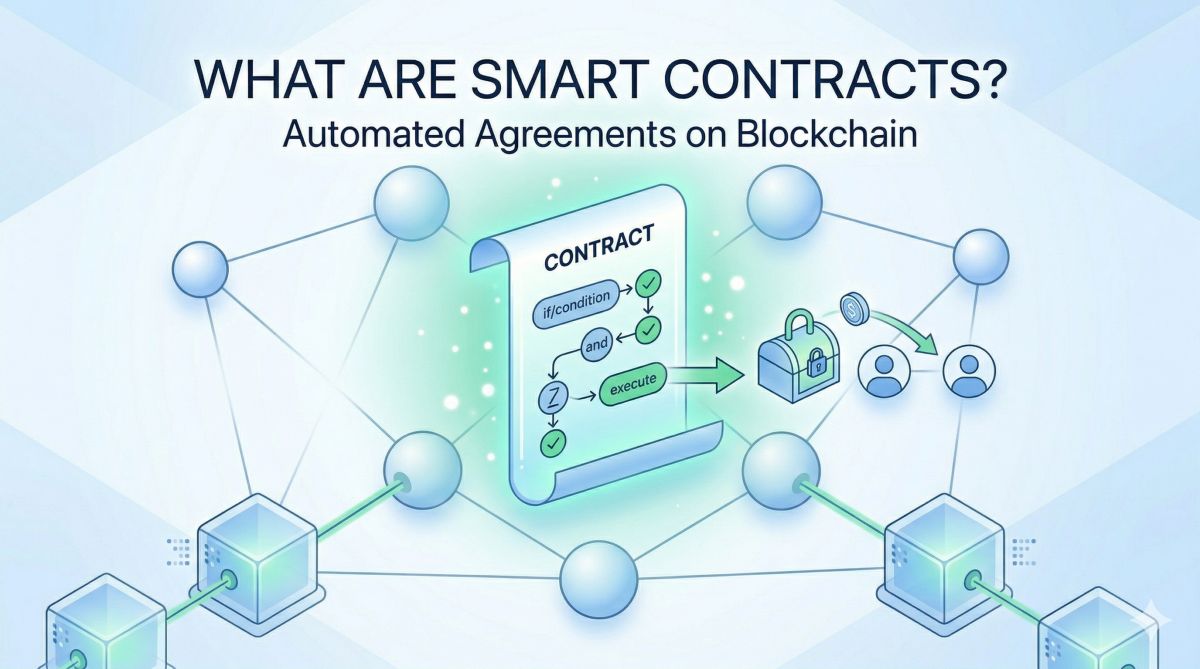
Smart contracts operate on a very simple logical premise: "If/When X happens, then execute Y." Here is the step-by-step process of how they automate the digital economy:
1. Writing the Code
Developers write the logic of the contract using specific programming languages. They define the exact conditions that must be met for an action to trigger. For example: "If Wallet A sends 100 tokens to the contract, then transfer ownership of the Digital Art (NFT) to Wallet A."
2. Deployment on the Blockchain
Once the code is written and audited for security, it is uploaded to the decentralized blockchain network. At this point, it is encrypted, distributed across thousands of nodes, and becomes active.
3. Trustless Execution
When a user interacts with the contract and meets the predefined conditions, the blockchain network verifies the data. If everything matches the code, the contract automatically executes the transaction. There is no waiting for business hours, no manager approvals, and no paperwork.
The Undeniable Advantages of Smart Contracts
Why are tech companies and financial institutions rushing to adopt this technology? The benefits are game-changing:
- Absolute Automation: Processes that used to take weeks of legal back-and-forth now happen in seconds.
- Unprecedented Transparency: The code is public (open-source). Anyone can read the contract to see exactly what will happen with their funds before they commit to it.
- High-Level Security: Because they live on a blockchain, smart contracts are protected by advanced cryptography, making them incredibly resistant to hacking or unauthorized alterations.
- Trustless Environment: You don't need to trust the person on the other side of the screen. You only need to trust the code. The elimination of intermediaries (lawyers, brokers, banks) significantly reduces operational costs.
What Powers the Web3 Economy?
Smart contracts are the invisible engine powering the entire Web3 movement. Without them, there would be no Decentralized Finance (DeFi) platforms allowing you to earn interest. There would be no NFT marketplaces for digital artists. There would be no Decentralized Exchanges (DEXs) allowing peer-to-peer token swaps.
As we continue to develop utility-driven solutions at ZanaChain, our focus remains on leveraging secure, efficient smart contracts to build a fairer, faster, and more accessible internet for everyone. Understanding this technology is your key to unlocking the true potential of the decentralized future.