What Is a Crypto Airdrop? Free Token Distribution Explained
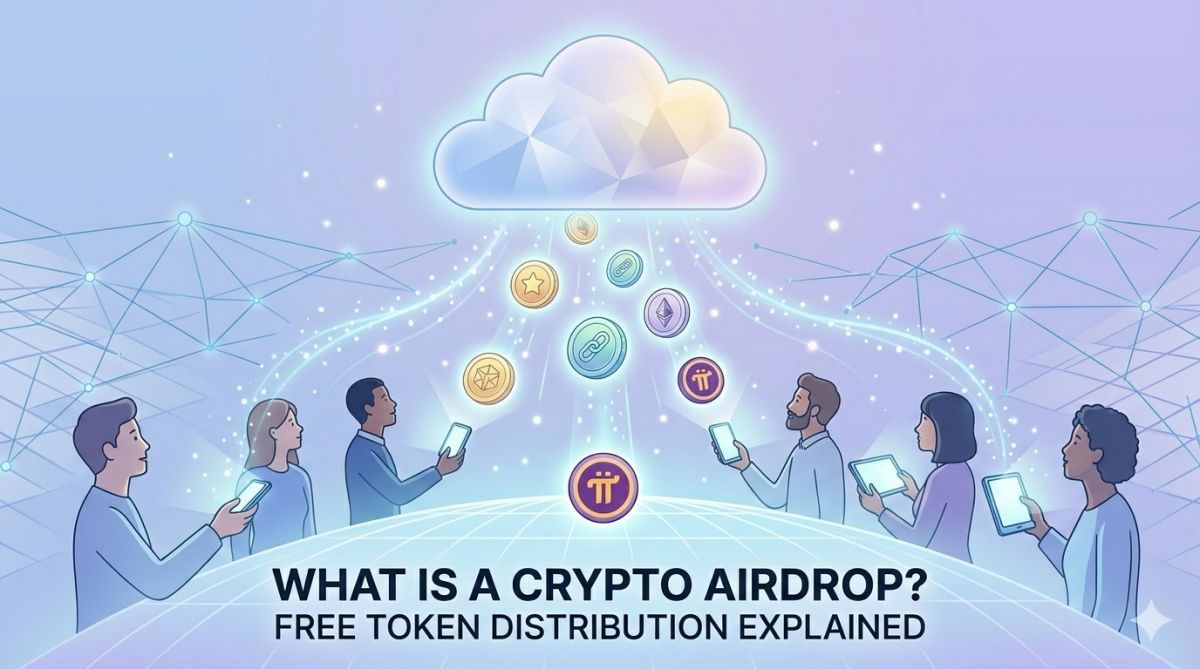
Who doesn't love free money? If a stranger on the street offered you thousands of dollars simply for testing out their new mobile app, you would immediately assume it was a scam. Yet, in the rapidly evolving Web3 ecosystem, this exact scenario happens regularly. It is a phenomenon known as the Crypto Airdrop.
For absolute beginners, the concept of developers giving away millions of dollars worth of digital assets for free seems completely illogical. However, at ZanaChain, we understand that community is the most valuable currency in the decentralized world. In this comprehensive guide, we will break down what an airdrop is, the hidden economic reasons why projects use them, the legendary "retroactive" rewards, and how to protect yourself from the dark side of free tokens.
What Is a Crypto Airdrop? The Coffee Shop Analogy
A Crypto Airdrop is a distribution mechanism where a blockchain project deposits free tokens directly into the Web3 wallets of its users or community members.
The Grand Opening Analogy: Imagine a brand-new, independent coffee shop opens in your neighborhood. To compete with the massive corporate chains, the owner stands on the sidewalk and hands out free cups of coffee to the first 500 people who walk by. The coffee costs the owner money, but in return, they generate massive hype, word-of-mouth marketing, and a loyal customer base who will come back to buy pastries tomorrow. An airdrop is the digital equivalent of this marketing strategy, but deployed on a global scale.
Why Do Projects Give Away Millions? (The Real Reasons)
Marketing is only the surface-level reason. The true motivations behind massive airdrops (like those from Uniswap, Arbitrum, or Optimism) are deeply rooted in Web3 economics and legal survival:
1. Achieving True Decentralization
If the founders of a project keep 100% of the tokens for themselves, the project is completely centralized. By airdropping tokens to hundreds of thousands of individual wallets, the token distribution becomes widely scattered. This is crucial for creating a fair Decentralized Autonomous Organization (DAO) where voting power is held by the community, not just a few insiders.
2. Regulatory Protection (The SEC Factor)
Government regulators (like the US SEC) often crack down on projects that sell tokens directly to investors to raise money, classifying them as illegal "unregistered securities." By giving the tokens away for free to actual users of the platform instead of selling them, projects attempt to bypass these strict security laws.
3. Bootstrapping Liquidity and Network Effects
A decentralized application (dApp) is useless without users. By promising a future airdrop, developers incentivize users to test their network, provide liquidity to their smart contracts, and find bugs before the official launch.
The 4 Main Types of Crypto Airdrops
Not all free tokens are distributed the same way. Here are the primary methods projects use to reward their communities:
1. Standard Airdrops (The Sign-Up)
This is the most basic form. Users simply provide their wallet address, join a Telegram group, or follow a Twitter account to receive a small number of tokens. Because they require almost no effort, the financial reward is usually very low.
2. Holder / Snapshot Airdrops
In this model, you are rewarded simply for holding a specific cryptocurrency. For example, a new project building on the Pi Network might announce an airdrop for anyone holding Pi coins. The developers take a "Snapshot" (a digital photograph of the blockchain ledger at a specific date and time) and distribute the new tokens proportionally to those wallets.
3. Bounty Airdrops
Users must perform specific tasks to earn the tokens. This could involve writing a blog post about the project, translating the whitepaper into another language, or finding coding bugs on the testnet. You are essentially working for the tokens.
4. Retroactive Airdrops (The Holy Grail)
This is where the massive wealth is generated. A project launches a protocol without a token. Users interact with the protocol (trading, bridging, or lending) for months. Suddenly, the project announces a governance token and retroactively rewards the earliest users based on their historical volume. In 2020, the Uniswap (UNI) retroactive airdrop famously gave users an average of $1,200 just for having made a single trade on their platform prior to the snapshot.
The Dark Side: Scams, Phishing, and Dusting Attacks
Because humans are naturally drawn to "free money," airdrops are the number one vector for cybercrime in the Web3 space. You must be relentlessly vigilant:
- The Phishing Link: Scammers create fake Twitter accounts that look exactly like official projects. They post a link saying "Claim your Airdrop Here!" When you connect your wallet and click "Approve," you are actually signing a malicious smart contract that instantly drains every asset in your wallet.
- The Dusting Attack: You might wake up to find a mysterious token worth "$50,000" sitting in your wallet. To sell it, you go to the provided website and connect your wallet. Boom. You are drained. These tokens are bait. If you don't recognize a token in your wallet, ignore it entirely.
Frequently Asked Questions (FAQ)
1. Do I have to pay taxes on Airdrops?
In most jurisdictions (including the US and much of Europe), the answer is Yes. Airdrops are generally treated as ordinary income based on their fair market value at the exact moment you receive them. Always consult a local tax professional.
2. Will anyone ever ask for my Seed Phrase for an airdrop?
Absolutely never. If any website, admin, or support bot asks for your 12 or 24-word seed phrase, or asks for a "gas fee deposit" to release your airdrop, it is 100% a scam.
Conclusion: Building Real Value
Airdrops are a fascinating and lucrative aspect of the decentralized economy. They democratize wealth, reward early adopters, and bootstrap vibrant communities. However, as the ecosystem matures, the focus is shifting from empty hype to rewarding genuine utility. At ZanaChain, our focus remains on engaging with ecosystems like the Pi Network, where real community contribution and active participation are the true drivers of long-term value. Stay safe, verify every link, and happy hunting!