What Is a Crypto Wallet? Secure Storage for Digital Assets
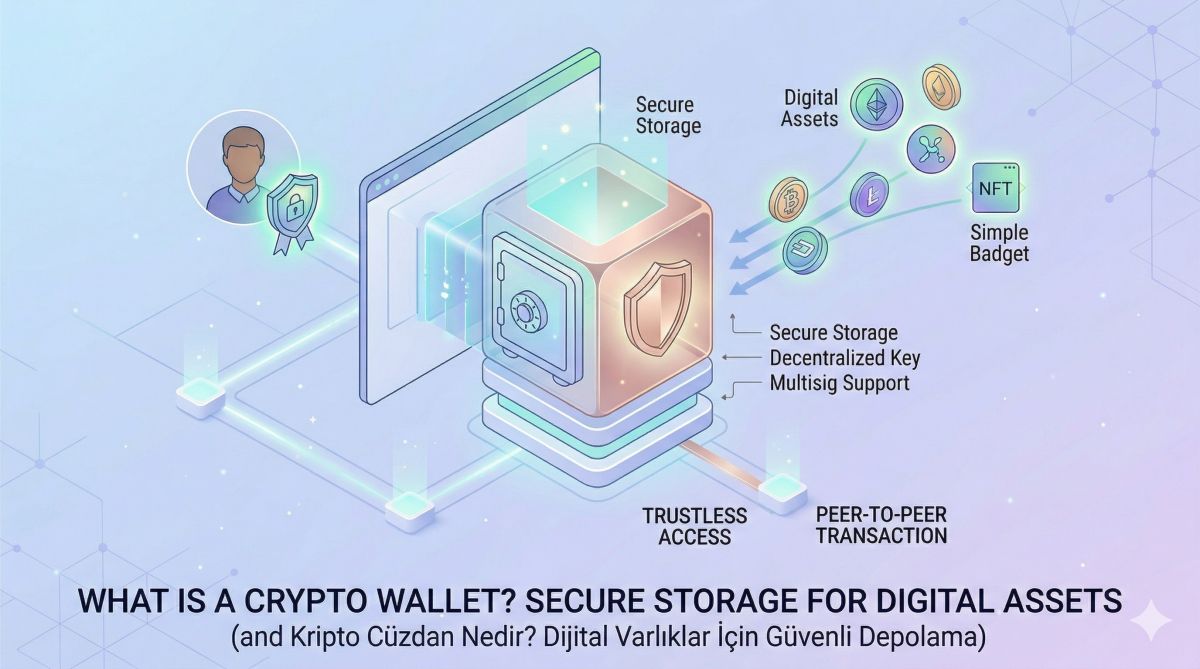
There is a famous saying in the cryptocurrency community: "Not your keys, not your coins." If you leave your digital assets on a centralized exchange, you don't actually own them—the exchange does in the form of an IOU. To achieve true financial sovereignty in the Web3 ecosystem, you must take custody of your own assets. This is where the Crypto Wallet comes into play.
At ZanaChain, our goal is to empower users to navigate decentralized applications (dApps) safely. Your wallet is your passport to this new digital economy. In this comprehensive guide, we will debunk the biggest misconceptions about crypto wallets, explain the cryptography that keeps them secure, and help you choose the right storage method for your digital wealth.
The Biggest Misconception: Wallets Don’t Hold Coins
When you put a physical dollar bill into your leather wallet, the money is physically inside it. Because of this, most beginners assume that a crypto wallet actually "holds" their Bitcoin, Ethereum, or Pi Network coins. This is entirely false.
Your cryptocurrency never leaves the blockchain. It lives permanently on the decentralized ledger. What your crypto wallet actually holds are the cryptographic keys that prove you own those specific coins on the blockchain. If your wallet application gets deleted from your phone, your coins are perfectly safe on the blockchain—as long as you have backed up your keys.
Public Keys vs. Private Keys: The Bank Analogy
To understand how a wallet functions, you must understand the two mathematical keys it generates:
1. The Public Key (Your Account Number)
Your public key (which is hashed into a shorter "Wallet Address") is like your bank account number or your IBAN. It is perfectly safe to share this with anyone. If a friend wants to send you funds, you give them your public address. It looks like a long string of random letters and numbers (e.g., 0x1A2b3C...).
2. The Private Key (Your PIN / Password)
Your private key is the mathematical proof that gives you absolute control over the funds associated with your public address. Think of it as the PIN to your ATM card or the password to your online banking. You must never share your private key with anyone. Whoever controls the private key controls the money.
The Ultimate Master Key: The Seed Phrase
Managing raw private keys (which are massive lines of alphanumeric code) for different cryptocurrencies is difficult. To solve this, modern wallets use a Seed Phrase (or Recovery Phrase). This is a master password, usually consisting of 12 or 24 random English words generated when you first create the wallet (e.g., apple, ocean, table, rocket...).
This phrase can mathematically regenerate all your private keys. If you lose your phone or your computer breaks, you simply download a new wallet app, type in your 12-word seed phrase, and your funds are instantly restored. Write this phrase down on physical paper and store it in a fireproof safe. Never take a screenshot of it or save it in your email.
Types of Crypto Wallets: Hot vs. Cold
Not all wallets are created equal. Depending on your needs for security versus convenience, you will choose between Hot and Cold storage.
Hot Wallets (Connected to the Internet)
Hot wallets are software programs connected to the internet. They are incredibly convenient for daily trading, buying NFTs, or connecting to Web3 dApps.
- Mobile Wallets: Apps on your smartphone (e.g., Pi Wallet, Trust Wallet).
- Browser Extensions: Wallets built into your web browser (e.g., MetaMask, Phantom) that act as a bridge between you and decentralized platforms.
- Pros: Free, fast, highly accessible, and essential for Web3 interaction.
- Cons: Because they touch the internet, they are theoretically vulnerable to malware, phishing links, and hackers.
Cold Wallets (Offline Storage)
Cold wallets are physical devices that store your private keys completely offline. They are the gold standard for long-term security.
- Hardware Wallets: Devices that look like USB flash drives (e.g., Ledger, Trezor). When you want to make a transaction, you plug the device into your computer and physically press a button to sign it. The private keys never touch the internet.
- Paper Wallets: Literally printing your public and private keys on a piece of paper. (Highly secure from hackers, but vulnerable to fire, water, and loss).
- Pros: Maximum security against online threats and malware.
- Cons: They cost money, are less convenient for quick, daily transactions, and require physical safekeeping.
Custodial vs. Non-Custodial: Who Actually Owns the Money?
When you buy crypto on a massive centralized exchange like Binance or Coinbase, you are using a Custodial Wallet. The exchange holds the private keys and promises to give you your funds when you ask. If the exchange goes bankrupt or gets hacked, your money is gone.
A Non-Custodial Wallet (like MetaMask or a Hardware Wallet) gives the private keys directly to you. You are your own bank. At ZanaChain, we heavily advocate for non-custodial solutions, as they represent the true ethos of decentralization.
Frequently Asked Questions (FAQ)
1. What happens if I lose my phone with my crypto wallet on it?
As long as you have your 12-to-24-word Seed Phrase safely written down offline, you haven't lost anything. You can buy a new phone, download the wallet app, enter your phrase, and regain full access to your funds.
2. Can one wallet hold different types of cryptocurrency?
Yes, modern multi-currency wallets can hold hundreds of different digital assets across multiple blockchains (like Ethereum, Binance Smart Chain, and Polygon) all managed by a single master Seed Phrase.
3. Are crypto wallets free?
Software (Hot) wallets are 100% free to download and use. You only pay network transaction fees (gas fees) when you send funds. Hardware (Cold) wallets require purchasing a physical device, usually costing between $50 and $200.
Conclusion: Your Gateway to Web3
A crypto wallet is much more than a place to store digital money. It is your digital identity, your secure login to decentralized applications, and your vault for digital property. Whether you are interacting with the Pi Network ecosystem or exploring decentralized finance, securing your wallet is your most important responsibility. Stay safe, guard your seed phrase, and enjoy the true ownership that Web3 provides.