What Is a DAO? Decentralized Autonomous Organizations Explained
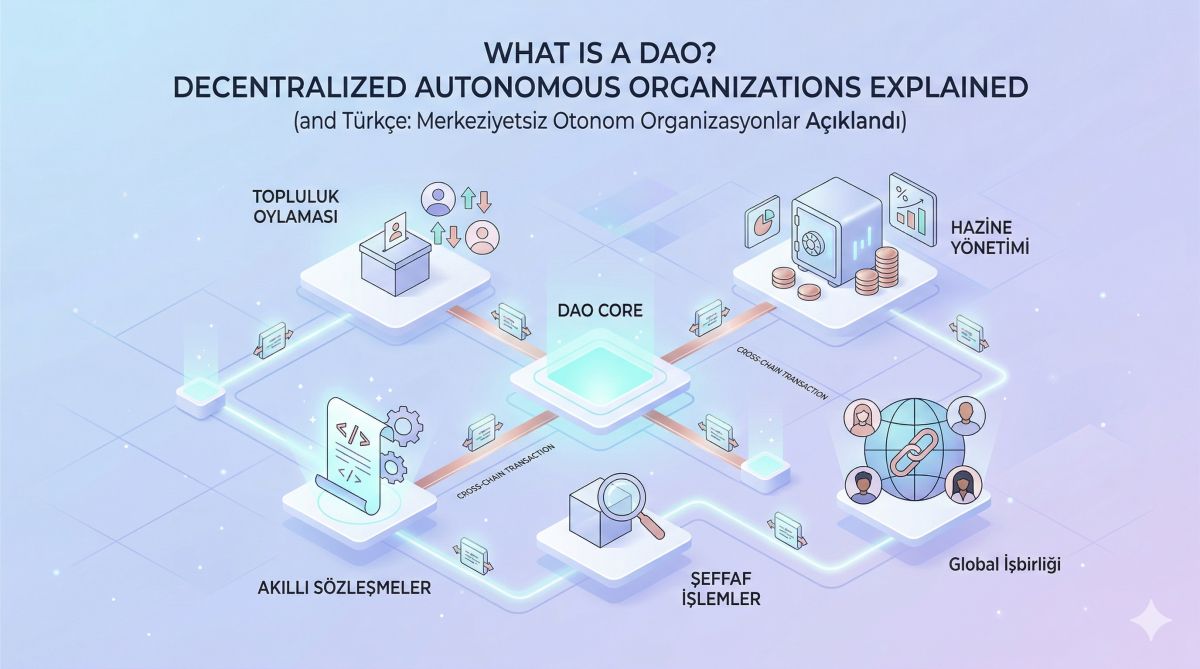
For hundreds of years, businesses and organizations have operated using the exact same top-down hierarchy: a CEO makes the rules, a board of directors approves them, and the employees follow them. But what if you could build a global company with millions of dollars in a shared bank account, but absolutely no CEO, no physical headquarters, and no middle managers?
Welcome to the world of the DAO (Decentralized Autonomous Organization). At ZanaChain, we believe that community-driven governance is the heartbeat of the Web3 revolution. In this comprehensive guide, we will explore what DAOs are, how they use blockchain technology to automate management, and why they are actively threatening the traditional corporate model.
What Exactly Is a DAO?
To truly understand the concept, we need to break down the acronym into its three core components:
- Decentralized: There is no central authority or single leader. Power is distributed equally (or proportionally) among all the members of the community.
- Autonomous: The rules of the organization are written directly into code (Smart Contracts). Once a decision is made, the code executes the action automatically without requiring a human manager to approve it.
- Organization: It is a group of individuals who pool their resources (usually cryptocurrency) and work together toward a shared mission or common goal.
In simple terms, an internet community with a shared bank account and a built-in, unhackable voting system.
How Do DAOs Actually Operate?
If there is no boss to make decisions, how does a DAO decide what to do with its funds or how to upgrade its software? The answer lies in Governance Tokens.
1. Funding and Token Issuance
When a DAO is created, it usually issues a digital token. Users who want to join the organization or support its mission buy these tokens. The money raised goes into the DAO's "Treasury"—a digital wallet secured by a smart contract.
2. The Voting Process (1 Token = 1 Vote)
Holding a governance token is like holding shares in a traditional company, but with direct voting power. If someone in the community has an idea (e.g., "Let's donate $50,000 to a Web3 developer fund" or "Let's change the fee structure of our dApp"), they submit a formal proposal.
Token holders then vote on this proposal. Usually, the more tokens you hold, the more voting power you have. If the proposal receives a majority vote, it passes.
3. Automated Execution
This is where the "Autonomous" part shines. In a traditional company, a CEO could simply ignore a vote. In a DAO, if the proposal to donate $50,000 passes, the smart contract automatically unlocks the treasury and sends the funds to the specified wallet. No human intervention is required, and no one can stop it.
Traditional Companies vs. DAOs
Why are tech enthusiasts and developers flocking to DAOs instead of forming standard LLCs or corporations? Let's compare the two models:
- Structure: Traditional companies are hierarchical (Top-down). DAOs are flat and democratic (Bottom-up).
- Transparency: Corporate finances are usually kept secret behind closed doors, audited only once a year. A DAO's treasury is located on a public blockchain; anyone can view every single transaction in real-time.
- Accessibility: Joining a corporate board requires wealth, connections, and dealing with geographic borders. Anyone with an internet connection and a Web3 wallet can buy a token and join a DAO from anywhere in the world.
Real-World Use Cases of DAOs
DAOs are not just theoretical concepts; they are managing billions of dollars in the Web3 ecosystem right now.
- DeFi Protocols: Massive decentralized finance platforms like Uniswap and MakerDAO are entirely governed by their token holders. The community votes on interest rates, software upgrades, and marketing budgets.
- Investment Clubs: Groups of investors pool their crypto into a DAO treasury to collectively purchase expensive assets, such as rare NFTs or virtual real estate, sharing the profits.
- The ConstitutionDAO Example: In 2021, a group of internet strangers formed a DAO and raised over $40 million in just a few days to try and buy an original copy of the US Constitution at a Sotheby's auction. While they ultimately lost the bid, it proved the incredible speed and power of decentralized organization.
Challenges and Risks of DAOs
At ZanaChain, we are passionate about Web3, but we also acknowledge its flaws. DAOs face significant challenges:
- Smart Contract Vulnerabilities: Because "code is law" in a DAO, if there is a bug or a loophole in the smart contract code, hackers can drain the entire treasury, and there is no legal authority to reverse the transaction.
- Voter Apathy: Just like in real-world politics, it can be difficult to get token holders to actually read proposals and vote, leading to decisions being made by a small, active minority.
- Regulatory Uncertainty: Governments around the world are still struggling to classify DAOs. Are they corporations? Partnerships? The legal framework is currently a massive gray area.
Frequently Asked Questions (FAQ)
1. Can anyone create a DAO?
Yes. With modern Web3 tools and platforms, creating the smart contracts required to launch a DAO treasury and issue governance tokens can be done in a matter of minutes, without knowing how to code.
2. Do I need to reveal my identity to join a DAO?
No. One of the core principles of Web3 is pseudonymity. You interact with the DAO using your Web3 wallet address. You are judged by your contributions and your votes, not your real-world identity, nationality, or background.
Conclusion: The Future of Collaboration
DAOs represent a fundamental shift in human coordination. By replacing managers with smart contracts and boardroom secrecy with blockchain transparency, they offer a fairer, more inclusive way to build global projects. As ecosystems like the Pi Network continue to grow, community-driven governance models will become the standard, not the exception. The future of work is decentralized, and the DAO is its foundation.