What Is DeFi and How Is It Changing Finance
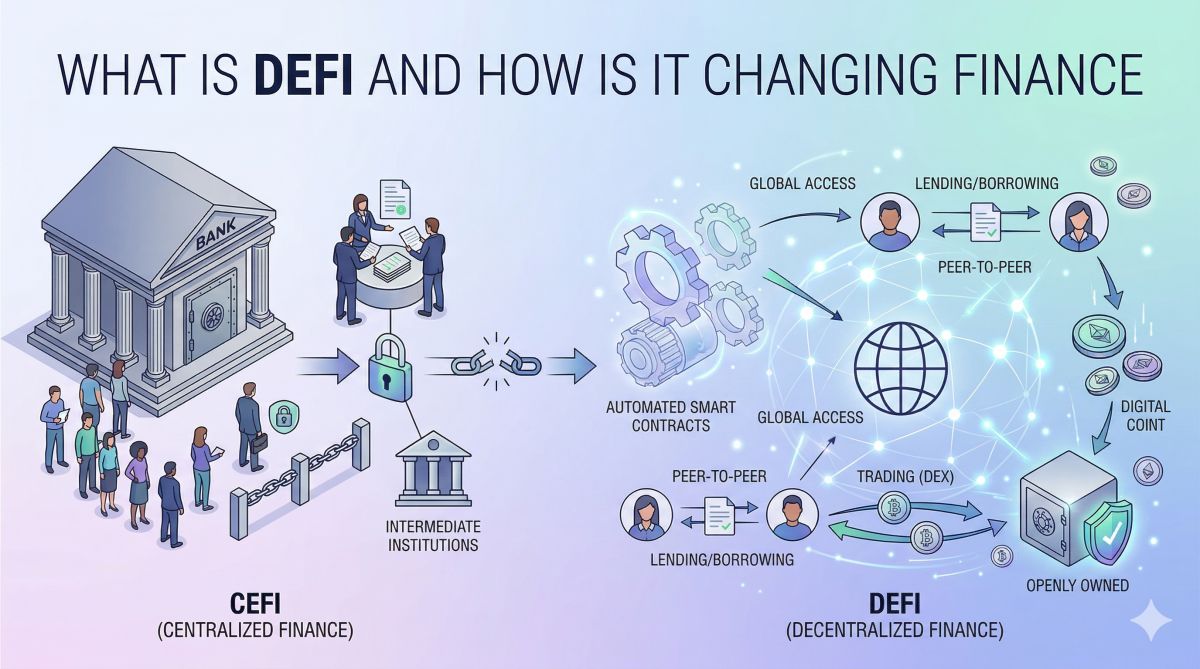
The global financial system is moving from a world of "Permissions" to a world of "Protocols." Decentralized Finance, or DeFi, is the revolutionary movement replacing traditional banks with transparent, automated smart contracts. Imagine a world where you can borrow, lend, and earn interest on your assets 24/7 without ever filling out a paper form or waiting for a bank manager's approval. At ZanaChain, we are witnessing how DeFi is democratizing wealth, providing 1.4 billion unbanked people with a smartphone-based digital economy. From Protocol 20 upgrades on the Pi Network to the tokenization of real-world assets, DeFi is not just an alternative to finance—it is the future of money itself.
What is DeFi? (Bye-Bye, Middlemen)
In the traditional world (TradFi), every time you move money, a middleman takes a slice. Banks, brokers, and insurance companies act as centralized gatekeepers who control your access to your own capital. DeFi (Decentralized Finance) removes these gatekeepers by using blockchain-based Smart Contracts.
A smart contract is like a digital vending machine: you put in the required collateral, and the contract automatically gives you a loan. There is no credit check, no discrimination, and no human error. The code is the law.
How DeFi is Changing the Financial Landscape in 2026
As we navigate through 2026, DeFi has evolved from "experimental" to "institutional." Here are the three ways it is reshaping our world:
1. Inclusion for the Unbanked
According to 2026 World Bank data, millions still lack access to basic banking. DeFi changes this by requiring only an internet connection and a wallet. For the Pi Network community, this means that every Pioneer with a verified wallet is now their own bank. You can participate in global liquidity pools and lending protocols directly from your mobile device.
2. Tokenization of Real-World Assets (RWA)
The biggest trend of 2026 is RWA Tokenization. DeFi is no longer just about "magic internet money." We are now seeing real estate, gold, and even government bonds being "tokenized" and traded on decentralized platforms. This allows regular people to buy a 0.1% share of a high-value property and earn rent in the form of stablecoins—all through a smart contract.
3. Yield Farming and Passive Income
In a traditional bank, your savings might earn 1-2% interest while the bank lends it out at 15%. In DeFi, you are the lender. By providing liquidity to decentralized exchanges (DEXs) or lending protocols, you receive the majority of the interest and trading fees yourself. This "Real Yield" model has become a cornerstone of the 2026 digital economy.
The Pi Network Context: Protocol 20 and Beyond
The Protocol 20 upgrade (March 2026) is a game-changer for Pi-based DeFi. It has unlocked the technical foundation for:
- Pi-Native Stablecoins: Reducing volatility for everyday payments.
- Escrow Services: Automated "Buyer-Seller" protection for the Pi Browser marketplaces.
- Subscription Contracts: Allowing dApps to offer recurring services paid automatically in PI.
At ZanaChain, we are building tools that leverage these smart contracts to ensure that every Pioneer can safely navigate the DeFi space without needing a degree in computer science.
The Risks: Security in an Automated World
While DeFi is powerful, it is "frontier technology." Major trends in 2026 show that while central hacks are decreasing, Bridge exploits and AI-driven phishing are on the rise.
- Smart Contract Risk: If the code has a flaw, it can be exploited. Always look for audited protocols.
- Self-Custody Responsibility: In DeFi, you are the bank manager. If you lose your 24-word passphrase, there is no "Forgot Password" button.
- Regulatory Shifts: With the recent 2026 SEC/CFTC joint interpretations, compliant DeFi protocols are becoming the gold standard for long-term safety.
Frequently Asked Questions (FAQ)
1. Is DeFi legal?
Yes, in most major jurisdictions. As of March 2026, frameworks like the EU's MiCA and new U.S. guidelines have provided clear paths for compliant DeFi operations, making it safer for institutional and retail users alike.
2. Do I need a lot of money to start with DeFi?
No. That is the beauty of it. You can start with as little as $1 (or a few PI). Unlike traditional private banking, there is no minimum balance requirement to access high-level financial tools.
3. How does ZanaChain fit into DeFi?
ZanaChain develops dApps that simplify the DeFi experience. We focus on "Abstracting the Complexity"—making sure you can use a lending protocol or a swap tool as easily as you use a social media app.
Conclusion: The New Financial Sovereignty
DeFi is more than a technological trend; it is a shift in the power dynamics of the world. By returning control of money to the people, we are creating a more transparent, efficient, and inclusive global economy. Whether you are a long-time crypto enthusiast or a Pioneer just starting your journey, understanding DeFi is the key to unlocking the true potential of the Web3 era. The bank of the future isn't a building on a street corner—it's the code in your pocket. And at ZanaChain, we are proud to be building that future with you.