What Is Layer 2 in Blockchain? Scaling Solutions Explained
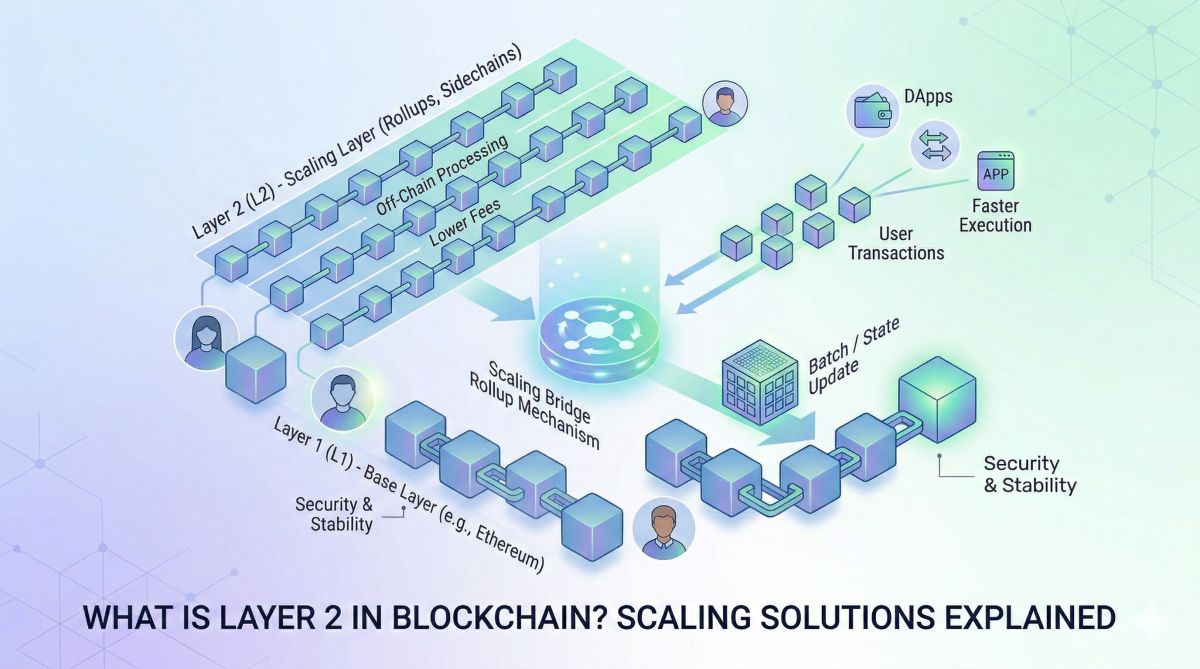
If you have ever tried to buy an NFT or swap tokens on the Ethereum network during a busy day, you likely experienced a massive shock: the transaction fee (Gas Fee) might have cost more than the asset itself! As blockchain technology explodes in popularity, the foundational networks are struggling to keep up with the sheer volume of users.
At ZanaChain, we know that for Web3 to truly replace traditional finance and internet infrastructure, it must be fast, seamless, and cost mere pennies to use. The solution to this massive bottleneck is Layer 2 (L2) Scaling Solutions. In this comprehensive guide, we will break down what Layer 2 is, how it solves the infamous "Blockchain Trilemma," and why it is the ultimate key to global Web3 adoption.
The Root of the Problem: The Blockchain Trilemma
To understand why we need a "Layer 2," we first must understand the limitations of "Layer 1." Layer 1 (L1) refers to the main blockchain architecture itself—networks like Bitcoin, Ethereum, or Solana.
Vitalik Buterin, the co-founder of Ethereum, coined the term "The Blockchain Trilemma." It states that a blockchain can only successfully achieve two of the following three goals at the same time:
- Decentralization: The network is run by thousands of independent computers globally.
- Security: The network is mathematically unhackable and immune to attacks.
- Scalability: The network can process thousands of transactions per second instantly.
Blockchains like Bitcoin and Ethereum chose to prioritize Security and Decentralization. Because every single node (computer) on the network must verify every single transaction, the process is incredibly secure, but painfully slow. When millions of people try to use the network at once, a massive traffic jam occurs. Fees skyrocket, and transactions take hours.
What Is Layer 2? The Highway Analogy
Layer 2 refers to a secondary framework or protocol built directly on top of an existing blockchain (Layer 1). Its sole purpose is to increase transaction speed and scale the network.
The Traffic Analogy: Imagine Layer 1 as a busy, single-lane city street with strict security checkpoints. It is very safe, but traffic moves at a crawl. Layer 2 is like a multi-lane, high-speed overpass built directly above that street. Cars (transactions) get on the overpass, drive at lightning speed, and only merge back down to the city street when they reach their final destination. The security checkpoint only has to check the cars once they get off the overpass, saving massive amounts of time.
How Do Layer 2 Solutions Actually Work?
There are several different technological approaches to building these "overpasses." Here are the three most prominent Layer 2 architectures powering the Web3 ecosystem today:
1. Rollups (The Industry Standard)
Rollups are currently the most popular L2 solution (used by networks like Arbitrum, Optimism, and Base). A rollup literally "rolls up" or bundles hundreds of transactions into a single massive transaction off-chain.
Think of it like buying drinks at a bar. Instead of swiping your credit card for every single drink (which takes time and incurs fees), you open a "tab." At the end of the night, you pay for all 10 drinks with one single card swipe. Rollups do this mathematically. They process thousands of transactions on Layer 2, and then submit one single "receipt" (proof) to the Layer 1 blockchain. There are two main types of rollups:
- Optimistic Rollups: They assume every transaction in the bundle is valid and honest by default. They only perform mathematical checks if someone actively reports a fraudulent transaction (a "Fraud Proof").
- Zero-Knowledge Rollups (ZK-Rollups): They use incredibly complex cryptography to instantly prove that a bundle of transactions is valid without having to reveal the data of the transactions themselves. They are faster and more private but harder to build.
2. State Channels
State channels allow two parties to open a direct, private communication line off-chain. They can transact with each other thousands of times instantly and for free. Only the very first transaction (opening the channel) and the very last transaction (closing the channel and settling the final balance) are recorded on the Layer 1 blockchain. The Bitcoin Lightning Network is the most famous example of a state channel, allowing for instant Bitcoin micro-payments.
3. Sidechains
Sidechains are separate, independent blockchains that run parallel to the main Layer 1. They have their own consensus mechanisms and security rules but connect to the main chain via a two-way bridge. While highly scalable, they are often considered less secure than true Rollups because they do not fully inherit the security of the Layer 1 network.
Why Layer 2 is Essential for the Future of Web3
Without Layer 2 scaling, the dream of a decentralized internet dies. At ZanaChain, we are acutely aware that mass adoption requires a Web2-like user experience. Layer 2 makes this possible by providing:
- Microtransactions: You cannot buy a $2 cup of coffee with crypto if the transaction fee is $15. Layer 2 drops fees to fractions of a cent.
- Complex DeFi and Gaming: Decentralized video games (GameFi) require thousands of rapid transactions per minute (moving characters, looting items). This is impossible on L1 but seamless on L2.
- Environmental Sustainability: By processing thousands of transactions at once, Layer 2 drastically reduces the energy consumption required per transaction.
Frequently Asked Questions (FAQ)
1. Is my crypto less secure on a Layer 2 network?
True Layer 2 solutions (like Rollups) derive 100% of their security from the underlying Layer 1 blockchain. If you use an Ethereum Rollup, your funds are secured by the main Ethereum network. The mathematical proofs ensure your money cannot be stolen by the L2 operators.
2. Do I need a different wallet to use Layer 2?
No. Standard Web3 wallets (like MetaMask or Trust Wallet) fully support Layer 2 networks. You simply add the L2 network settings to your existing wallet, and you can use the exact same wallet address.
3. How do I move my funds to a Layer 2?
To move assets from a Layer 1 to a Layer 2, you use a decentralized application called a Bridge. You lock your tokens in a smart contract on L1, and the bridge mints the exact equivalent amount of tokens for you to use on L2.
Conclusion: The Scaling Era
The first decade of cryptocurrency was about proving that decentralized money and smart contracts were possible. The next decade is about making them scalable for 8 billion people. Layer 2 solutions are the technological marvels that will finally allow Web3 to handle the speed of global commerce. As ZanaChain continues to build within innovative ecosystems, leveraging scalable infrastructure remains our top priority to deliver truly useful, lightning-fast decentralized applications.