What Is Proof of Stake? A Modern Blockchain Consensus Mechanism
For the first decade of cryptocurrency's existence, the technology had a massive public relations problem: it required the energy consumption of a small country just to keep the network secure. The traditional "Proof of Work" (mining) system was revolutionary, but it was incredibly slow, expensive, and environmentally damaging.
To build a decentralized internet (Web3) that 8 billion people can use daily, the infrastructure needed a massive upgrade. Enter Proof of Stake (PoS). At ZanaChain, we believe that sustainability and scalability are non-negotiable for the future of decentralized applications (dApps). In this comprehensive guide, we will break down what Proof of Stake is, how it secures billions of dollars without burning coal, and why it has become the gold standard for modern blockchain networks.
The Problem with the Old System (Proof of Work)
To appreciate PoS, we must briefly understand what it replaced. In a Proof of Work (PoW) system like Bitcoin, physical computers (miners) compete to solve incredibly complex math puzzles. The winner gets to add the next block of transactions to the chain and receives newly minted coins.
Because the competition is fierce, miners buy warehouses full of expensive, power-hungry machines (ASICs). This creates a massive barrier to entry for normal people and limits the network to processing only a few transactions per second. The Web3 economy simply cannot run on this kind of bottleneck.
What Is Proof of Stake? The "Security Deposit" Analogy
Proof of Stake (PoS) is a consensus mechanism that completely eliminates the need for physical mining machines and complex math puzzles. Instead of securing the network with electricity and hardware, PoS secures the network using capital (the cryptocurrency itself).
The Apartment Lease Analogy: Imagine you want to rent a luxury apartment. The landlord doesn't know you, so they ask for a $5,000 security deposit. If you take good care of the apartment and follow the rules, you get your money back (plus maybe some interest). But if you trash the apartment or break the lease, the landlord confiscates your deposit.
Proof of Stake works exactly like this. To become a network auditor (called a Validator), you must lock up a certain amount of your own cryptocurrency into a smart contract. This is your "stake" or security deposit. As long as you honestly verify transactions, you earn rewards. If you try to cheat the system, your money is destroyed.
How Proof of Stake Actually Works (Step-by-Step)
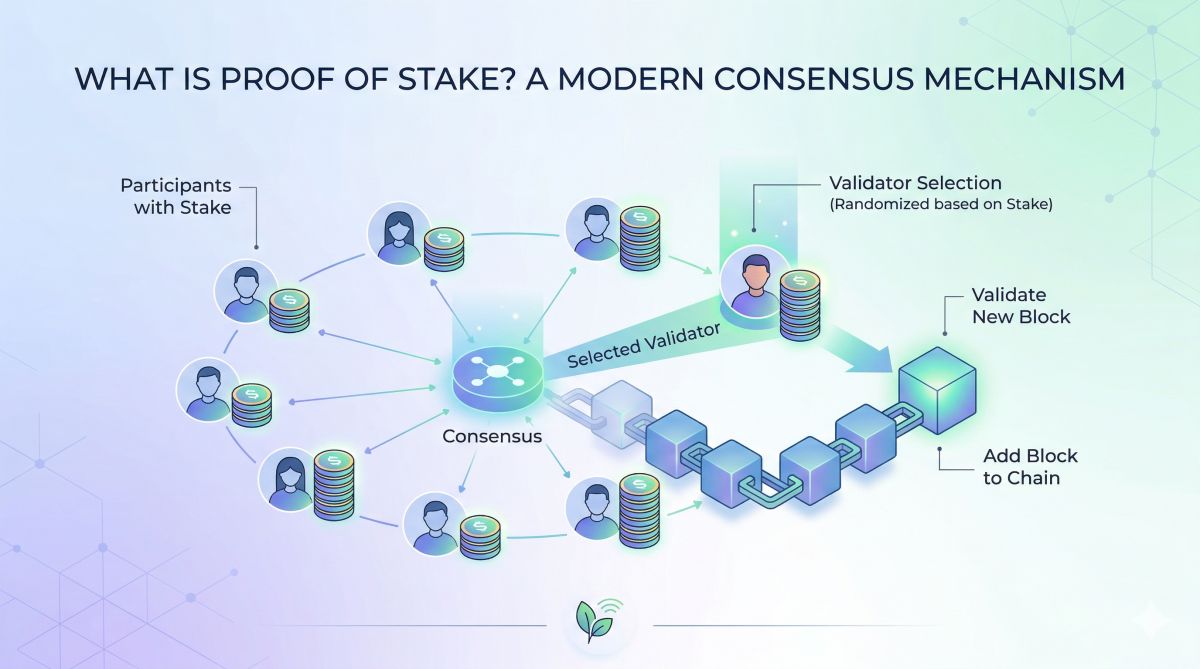
Here is the mechanical breakdown of how a transaction gets approved on a modern PoS network like Ethereum, Solana, or Cardano:
1. Staking the Collateral
Users who want to participate lock their crypto assets in a designated smart contract. This capital acts as their skin in the game.
2. The Validator Selection Roulette
When a new block of transactions needs to be verified, the network’s algorithm randomly selects a validator to do the job. However, the randomness is weighted: the more crypto you have staked, the higher your chances of being chosen. (If you hold 5% of all staked tokens, you will be chosen to validate roughly 5% of the blocks).
3. Verification and Attestation
The chosen validator checks the transactions in the block. Are there enough funds? Is anyone double-spending? Once they approve it, a committee of other validators double-checks the work (called attestation).
4. Rewards vs. Slashing
If the block is legitimate, it is added to the blockchain, and the validator earns a reward (newly minted coins and transaction fees). However, if the validator tries to approve a fraudulent transaction or goes offline for too long, the network automatically executes a "Slashing" penalty. A portion (or all) of their staked crypto is permanently destroyed. The financial pain of cheating is always mathematically higher than the potential profit.
The Revolutionary Advantages of PoS
Why did Ethereum spend years executing "The Merge" to switch from PoW to PoS? The benefits are monumental:
- 99.9% Energy Reduction: Because there are no math puzzles to solve, validators can run the software on a standard laptop. The network's carbon footprint drops to almost zero.
- Democratization of Security: You don't need to buy $10,000 mining rigs. Anyone with a small amount of crypto can join a "Staking Pool" and start earning passive income while securing the network.
- Massive Scalability: Without the heavy computing overhead, PoS networks can process thousands of transactions per second, making them ideal for high-frequency DeFi trading and global dApps.
- Stronger Economic Security: In PoW, a billionaire could buy enough hardware to attack the network (a 51% attack). In PoS, they would have to buy 51% of all the crypto in existence, which would skyrocket the price and instantly bankrupt them if the network slashed their funds.
Valid Criticisms: Is PoS Perfect?
To maintain absolute objectivity, we must look at the flaws of Proof of Stake:
- The "Rich Get Richer" Problem: Because your chances of being chosen to earn rewards depend on how much you stake, wealthy users naturally accumulate more coins faster than small users, potentially leading to wealth centralization.
- Lock-up Periods: Many networks force you to lock your coins for weeks or months. If the market crashes, you cannot sell your staked assets immediately. (Though innovations like Liquid Staking are solving this).
Frequently Asked Questions (FAQ)
1. Do I need a supercomputer to stake?
Not at all. Unlike mining, staking simply requires your node to be online and connected to the internet. Many users stake directly from their Web3 wallets or through secure exchanges without running any hardware themselves.
2. Can I lose my crypto while staking?
Yes. If you run your own validator node and configure it incorrectly, or if you delegate your tokens to a malicious validator, you can be subjected to slashing penalties. Always choose reputable staking providers.
Conclusion: The Sustainable Foundation of Web3
Proof of Stake is not just a technical upgrade; it is a philosophical shift in how we build global trust. By replacing wasteful energy consumption with aligned economic incentives, PoS has provided the scalable, eco-friendly foundation that decentralized finance, NFTs, and global smart contracts desperately needed. As ZanaChain continues to develop within innovative ecosystems, we prioritize building on sustainable, fast, and secure consensus mechanisms that benefit both the user and the planet.