What Is Tokenomics? Understanding Crypto Economic Models
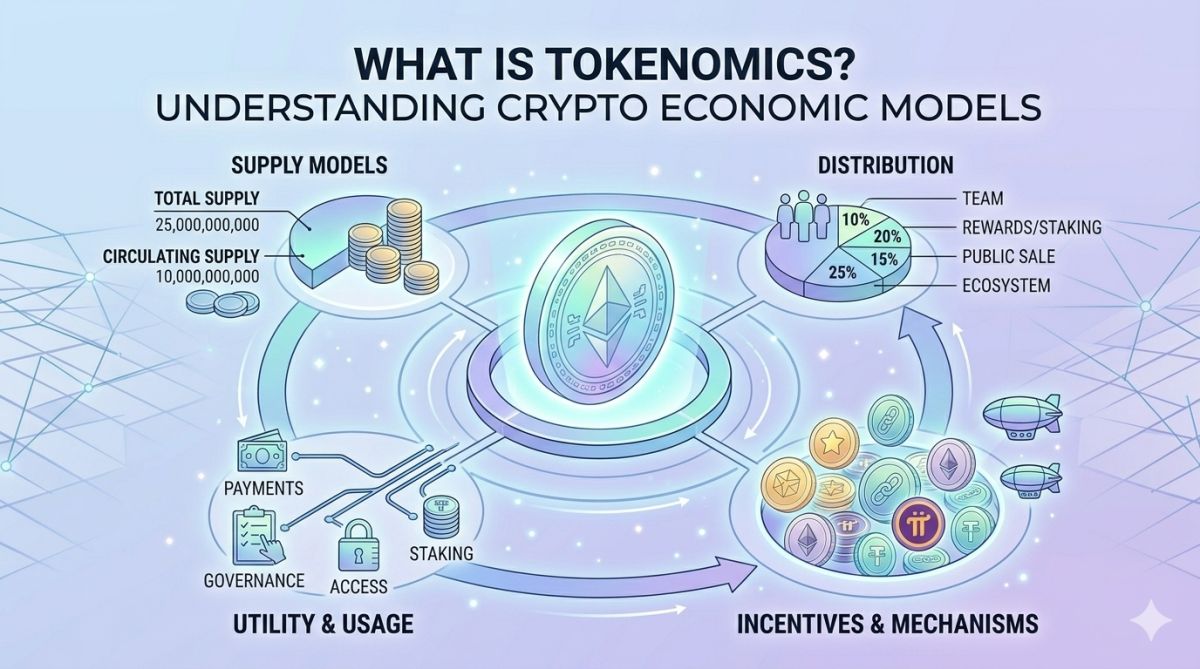
Every year, thousands of new cryptocurrencies launch with beautiful websites, massive marketing campaigns, and promises to revolutionize the world. Yet, statistics show that over 90% of these projects will see their token price crash to near zero within a few years. Why does this happen? The answer rarely lies in bad code or hacking; the answer almost always lies in terrible Tokenomics.
At ZanaChain, we know that building a sleek Decentralized Application (dApp) is only half the battle. If the economic engine driving the underlying token is broken, the project will inevitably fail. In this comprehensive guide, we will explore the science of Tokenomics, how it acts as the monetary policy of the Web3 world, and how to spot the red flags of a doomed project before you invest.
What Is Tokenomics? The Central Bank Analogy
Tokenomics (a combination of "Token" and "Economics") refers to the fundamental mathematics, incentives, and rules that govern a cryptocurrency's ecosystem. It dictates how a token is created, how it is distributed, and what gives it value.
Think of traditional fiat money like the US Dollar or the Euro. A nation's Central Bank controls the monetary policy: they decide when to print more money (causing inflation) and when to raise interest rates. In the Web3 world, there is no Central Bank. Instead, the monetary policy is hardcoded directly into Smart Contracts. Once deployed, these rules are transparent, immutable, and strictly enforced by mathematics, not politicians.
The 4 Pillars of a Strong Tokenomic Model
To evaluate whether a cryptocurrency is a sustainable investment or a ticking time bomb, you must analyze its four core economic pillars:
1. Supply Mechanics (Inflation vs. Scarcity)
Supply and demand is the most basic law of economics. If a token has an infinite supply and no demand, its price will mathematically trend toward zero. You must understand three crucial supply terms:
- Circulating Supply: The number of tokens currently available to be bought and sold on the open market right now.
- Max Supply: The absolute maximum number of tokens that will ever exist. For example, Bitcoin has a hard-coded Max Supply of 21 million. It is perfectly scarce. Dogecoin, on the other hand, has no Max Supply; billions of new coins are printed every year.
- Total Supply: Tokens that have been created but are currently locked up and not yet circulating.
2. Token Distribution and Vesting Schedules
How were the tokens divided on day one? If the founders, venture capital (VC) investors, and insiders hold 60% of the token supply, the project is highly centralized. Worse, if those insiders are allowed to sell their tokens immediately, everyday retail investors simply become "exit liquidity" (the people buying while the founders cash out).
A healthy project uses a Vesting Schedule. This means the founders' and investors' tokens are cryptographically locked in a smart contract and slowly released over a period of 2 to 5 years. This aligns their incentives with the long-term success of the project.
3. Utility (The "Why")
A token is absolutely worthless if there is no reason to buy or hold it. This is the difference between a speculative "meme coin" and a fundamental Web3 asset. Real utility creates constant buying pressure. Examples of strong utility include:
- Network Gas Fees: To make a transaction on Ethereum, you must pay the network in ETH. This gives Ethereum massive intrinsic value.
- Governance: Tokens that give holders the right to vote on the future direction of a Decentralized Autonomous Organization (DAO).
- Staking and Yield: Locking up the token to secure the network in exchange for a percentage yield.
4. Burn Mechanisms (Deflation)
While some tokens print new supply (inflationary), others destroy their supply (deflationary). A Burn Mechanism is a smart contract function that sends tokens to a "dead" wallet address that no one can access, permanently removing them from circulation. If the demand stays the same but the supply decreases through burning, the price of the remaining tokens mathematically goes up. (Ethereum introduced a major burn mechanism with the EIP-1559 upgrade, burning a portion of every transaction fee).
Frequently Asked Questions (FAQ)
1. What is Market Cap vs. Fully Diluted Valuation (FDV)?
This is the most common mistake beginners make. Market Cap is the current price of the token multiplied by its Circulating Supply. However, Fully Diluted Valuation (FDV) is the current price multiplied by its Max Supply. If a token has a $10 Million Market Cap but a $2 Billion FDV, it means 99% of the tokens are still locked up. When those tokens unlock and flood the market, the price will crash aggressively.
2. Are inflationary tokens always bad?
No. A small, predictable amount of inflation is often necessary to reward miners or validators for securing the network over the long term. The problem arises when inflation (token printing) vastly outpaces network growth and user adoption.
Conclusion: Building Real Value
Tokenomics is the ultimate filter that separates visionary Web3 projects from short-term scams. As the industry matures, the days of printing billions of useless tokens are coming to an end. Ecosystems like the Pi Network are exploring sustainable, community-driven economic models that prioritize organic distribution over VC greed. At ZanaChain, our development philosophy revolves around creating dApps that give tokens real, tangible utility—because utility is the only true foundation for long-term value.