What Is Web3 Identity? The Future of Digital Ownership
How many passwords have you forgotten this year? How many times have you blindly clicked "Log In with Google" or "Log In with Facebook" just to read an article or buy a pair of shoes? For the last two decades, we have traded our privacy for convenience. In doing so, we handed over total control of our digital lives to a few massive tech corporations.
At ZanaChain, we believe that your digital identity should not belong to a server in Silicon Valley; it should belong to you. This is the foundational philosophy behind Web3 Identity. In this comprehensive guide, we will explore the transition from digital feudalism to Self-Sovereign Identity (SSI), the cryptography that makes it possible, and how it is revolutionizing the way we interact with the internet.
The Broken System: Web2 Identity (Digital Feudalism)
To understand why Web3 identity is so revolutionary, we must first look at the massive flaws of the current Web2 system. Today, you do not own your online identity. You are merely renting it from Big Tech companies.
When you use social media logins to access third-party websites, you are generating thousands of data points: what you buy, where you live, and what your political views are. These corporations package this data and sell it to advertisers. Furthermore, because they hold the ultimate master key, they can delete your account, erase your followers, and cut you off from the digital economy with a single keystroke. You have no legal recourse. You are the product.
What Is Web3 Identity? (Self-Sovereign Identity)
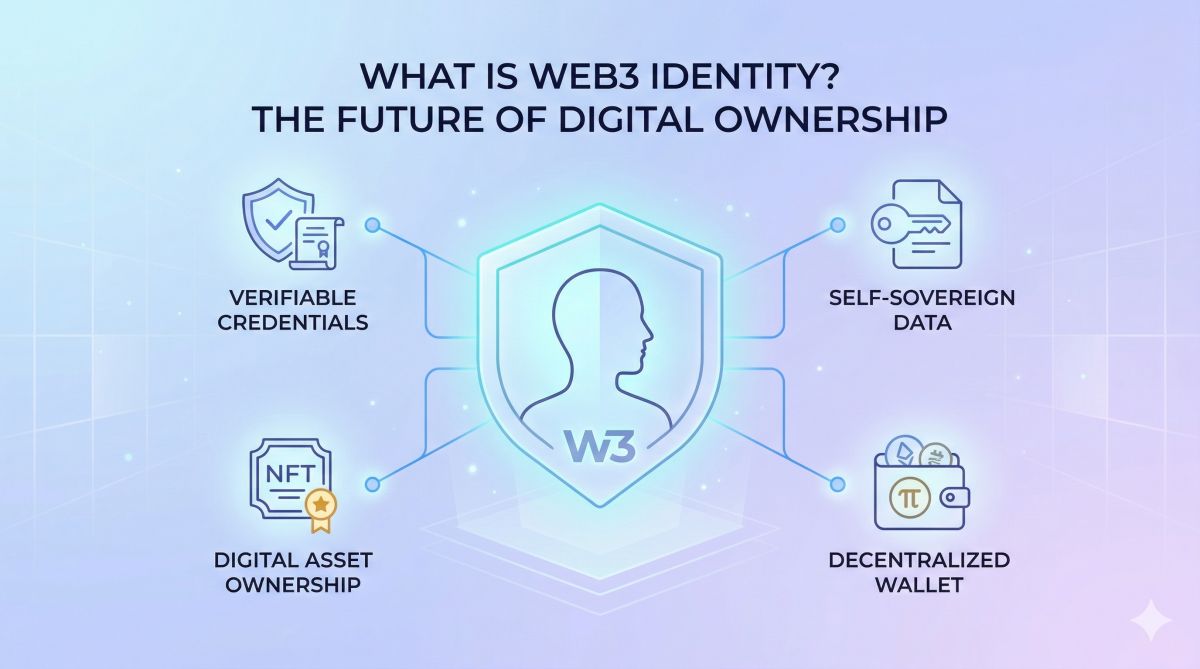
Web3 Identity flips this entire model upside down. It is built on the concept of Self-Sovereign Identity (SSI). SSI means that the individual user—not a corporation or a government—is the ultimate creator, controller, and owner of their digital identity.
Instead of creating an account with an email and a password on every single website, you use a decentralized Web3 wallet (like MetaMask, Trust Wallet, or the Pi Wallet). This wallet acts as your universal, cryptographic passport. When you visit a Decentralized Application (dApp), you simply click "Connect Wallet." The blockchain verifies your cryptographic signature in milliseconds, and you are instantly logged in. No passwords to forget, no emails to verify, and no personal data handed over.
Under the Hood: The Technology of Web3 Identity
How do we prove who we are without giving away our personal information? The Web3 ecosystem relies on several groundbreaking technologies:
1. Decentralized Identifiers (DIDs)
A DID is a unique string of letters and numbers tied to your wallet. Unlike a traditional username that is stored on a company's private database, a DID is registered on a public blockchain. It is mathematically impossible to forge, and no central authority can revoke it.
2. Zero-Knowledge Proofs (ZKPs): The Bouncer Analogy
Zero-Knowledge Proofs are the holy grail of Web3 privacy. Imagine you want to enter a nightclub that requires you to be over 21. In the Web2 world, you hand the bouncer your ID card. The bouncer now knows your exact birthdate, your full name, and your home address. You gave away too much data just to prove one simple fact.
With ZKPs, your Web3 wallet performs a complex mathematical calculation to generate a "Proof." You hand the digital bouncer this proof. The bouncer's system verifies it and simply reads: "True: This user is over 21." It reveals absolutely nothing else about you. You prove your eligibility while maintaining 100% privacy.
3. Soulbound Tokens (SBTs): Your Digital Reputation
If Web3 relies on anonymous wallets, how do we build trust? How do we know someone has a university degree or a good credit score? In 2022, Ethereum co-founder Vitalik Buterin introduced the concept of Soulbound Tokens (SBTs).
An SBT is exactly like an NFT, but with one massive difference: it cannot be sold or transferred. Once a university issues an SBT representing your medical degree to your wallet, it is permanently bound to your "soul" (your digital identity). This allows users to build verifiable, un-fakeable on-chain reputations (resumes, credit histories, KYC verifications) without relying on centralized credit bureaus.
The Undeniable Benefits of Decentralized Identity
The transition to Web3 identity unlocks massive benefits for the global economy:
- End of Massive Data Breaches: Hackers cannot steal millions of passwords from a central server because there is no central server. Every user guards their own keys.
- Censorship Resistance: A decentralized platform cannot de-platform you based on corporate policy because the infrastructure is governed by open-source smart contracts.
- Universal Portability: Your reputation travels with you. If you build a massive following on a Web3 social platform, you own your audience. You can instantly port your followers and data to a competing platform.
Frequently Asked Questions (FAQ)
1. Does Web3 identity mean I am completely anonymous?
Not exactly. Web3 is pseudonymous, not anonymous. While your real name isn't attached to your wallet address, your entire transaction history is permanently visible on a public ledger. If someone figures out that Wallet X belongs to you, they can see your entire digital history.
2. What happens to my identity if I lose my Seed Phrase?
This is the biggest challenge of Self-Sovereign Identity. Because there is no central authority, there is no "Forgot Password" button. If you lose your cryptographic keys (your seed phrase), you permanently lose access to your digital identity, your reputation, and your assets.
Conclusion: The Passport to the Metaverse
Web3 identity is about reclaiming our digital human rights. It replaces vulnerable passwords and greedy data brokers with unbreakable cryptography and user sovereignty. As ecosystems like the Pi Network onboard millions of KYC-verified users into the decentralized space, robust identity solutions will become the foundation of the new internet. At ZanaChain, we are committed to building dApps that respect your privacy, secure your data, and give you ultimate control over your digital footprint.